
“It’s like a cloud sometimes. You see the plumes extend from one side of the footpath to the other,” says Phil, who rents the shop to Moore and did not want his last name used because of privacy concerns. “It’s insane.”
But Moore and Phil worry the sand could be more than a nuisance. Could it be dangerous?
“When you’re getting off the tram, and you’re walking to the footpath, you’re walking through the plumes,” says Phil. They have read about the silicosis risk from stone benchtop cutting, which is now banned. “We’re all breathing it in all the time,” says Moore. “I was trying to find out what’s in it and how damaging it could be to people.”

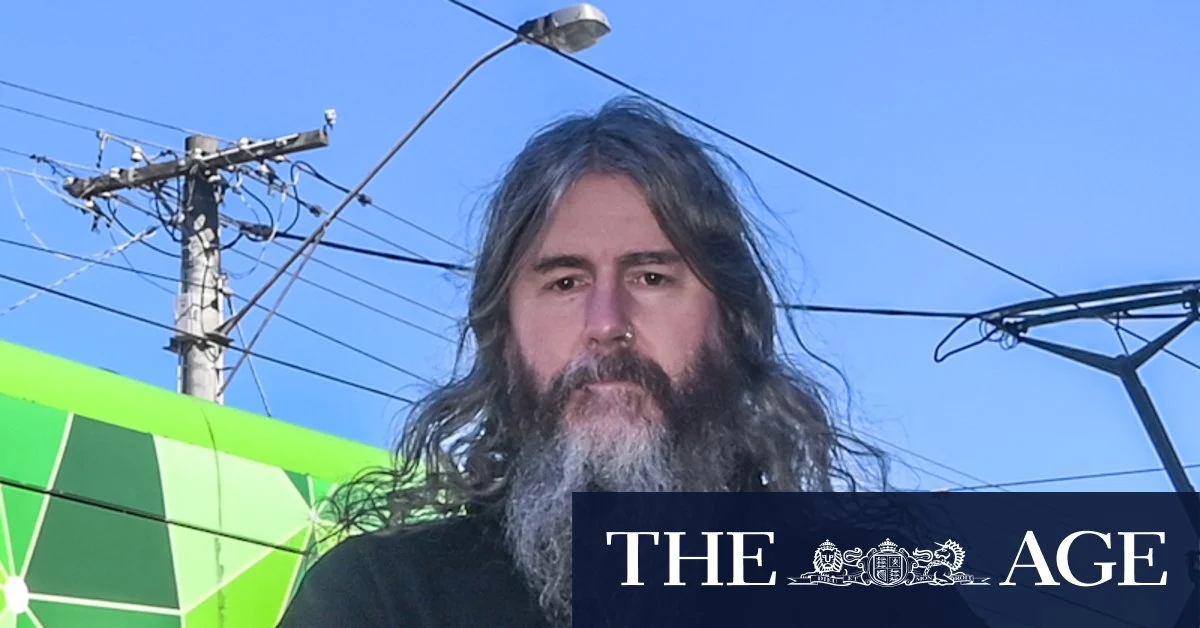
There is so much sand outside Moore’s shop he has to scoop it up.Credit: Justin McManus
Silicosis is a chronic long-term disease that can leave victims struggling to breathe; governments are only just starting to wake up to the risks from the explosion in the use of artificial stone benchtops.
It is caused when people breathe in tiny particles of crystalline silica, released from stone benches when they are sawed. The particles embed deep in the lung, triggering an inflammatory response.
“And they are toxic to the cells that clear dust particles,” says Dr Ryan Hoy, a Monash University respiratory physician who has led several studies of the disease. “Inflammation then causes scar tissue to form. And it’s the scar tissue which does all the damage to the lungs.”
The victims become trapped in a vicious cycle of inflammation and scarring, until their lungs harden and they struggle to breathe.
Silicosis has no cure, and can be fatal. The first case from artificial stone was reported in Australia in 2015; by 2022, there were almost 600 identified cases.
Crystalline silica can be found in artificial benchtops. It can also be found in tram sand, Yarra Trams confirmed.
Sand itself is not a risk, as the particles of silica are too large to breathe deep into the lungs. But tram sand is crushed beneath a 25-tonne tram.
“The sand does get crushed essentially into finer particles, and those particles are respirable crystalline silica,” says Kate Cole, co-chair of the National Silicosis Prevention Strategy Expert Steering Committee.
This masthead spent some time outside the front of Desert Highways this week, looking for large clouds of dust, but could only see small puffs near the trams’ wheels. Photos were provided to Hoy and Cole for analysis.
Loading
“My impression looking at this is that there would be extremely low risk of silica-associated disease,” says Hoy. “The sand shown is very large particles like sand at a beach, not the extremely fine dust that needs to be small enough to get deep into the lungs.”
He also noted the exposure was happening outside, where air could blow the silica away.
“It has to be extremely high intensity” exposure to get silicosis, he says. “Clouds of those microscopic particles for eight hours a day for a few weeks.”
Cole was less reassured by the images. “That is a lot of sand on the footpath – and that’s actually the concerning bit to me,” she says.
“When the trams run over it, the mechanical action is going to break the particles up into a fine dust, and some of that is going to be respirable crystalline silica. Any action like dry brush sweeping will result in silica dust being airborne – which equals a high exposure to silica dust.”
A spokeswoman for Yarra Trams said the company complied “with all state and federal laws and regulations and undertake regular checks across the tram network to protect our people and passengers”.
Yarra Trams staff who directly load the sand into the trams wear respiratory protective equipment and receive regular health monitoring including low-dose chest examinations and spirometry testing.
Yarra Trams has launched a project with RMIT researchers to investigate replacing tram sand with aluminum oxide. Results have not yet been reported.
Anthony Moore has tried to get Yarra Trams, or the local council, or the Environment Protection Authority out to look at his sand problem. No one seems to be taking him seriously.
“The council have basically told me to leave them alone,” he says.
Start the day with a summary of the day’s most important and interesting stories, analysis and insights. Sign up for our Morning Edition newsletter.