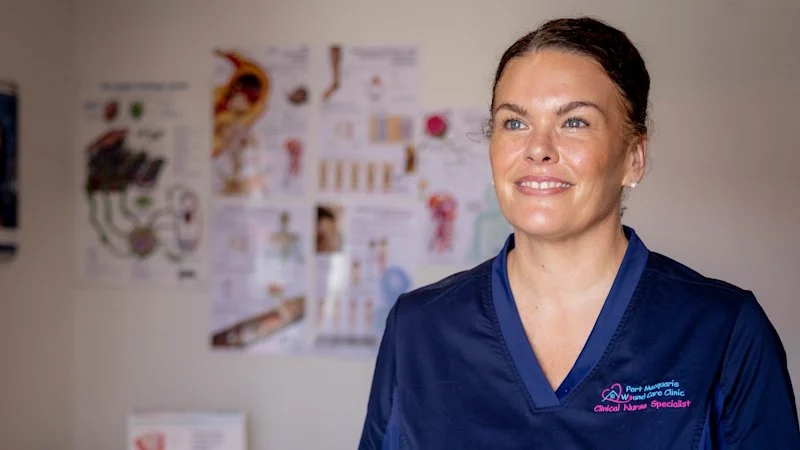

Nurse Melissa Freeman was working on an acute ward in 2016 when she took a plan to her bosses to get patients out of hospital quicker.
The idea was simple – a “transit lounge” for patients who were well enough to leave the hospital but had other factors, such as a lack of nursing home beds, holding them up. The pilot went well, but never jumped over the bureaucratic hurdles required to make it permanent. Fast-forward to 2026, and patients waiting for discharge to aged and disability care are occupying 1200 beds across NSW every night.
“We can’t be working that way any more if we want things to move forward,” says Freeman, who now runs a nurse-led clinic in Port Macquarie for patients with chronic conditions who would otherwise be waiting in the local emergency department.
For decades, NSW’s population data has warned of a tsunami of ageing and complex patients threatening to overwhelm the healthcare system. “The wave has genuinely crashed,” says the state’s chief health bureaucrat, NSW Health Secretary Susan Pearce.
Based on current projections, the state’s health system will be twice as busy by 2031. About half of that growth will be driven by patients aged over 65.
Pearce warned Health Minister Ryan Park about 18 months ago that if this trend holds, “it’ll be catastrophic,” Park recalls.
“That’s now coming to fruition in the worst way possible,” he said.
Ten years ago, the Herald projected the full force of the post-war baby boom would, by 2026, begin to impact the state’s health system. Now it’s here, we look back at what we got right, what we didn’t see coming (a pandemic, for one), and look at what Sydney’s health will look like beyond 2026.
More care at home, less in hospital
The COVID pandemic forced the state’s health system to go virtual fast. Park said government-funded urgent care clinics and virtual care hotlines are giving patients with less urgent conditions the chance to avoid the emergency department, “sitting there for 10 hours when you don’t really need to”.
St Vincent’s, which operates the public and private hospitals in Darlinghurst, has already announced half of their patients will be treated outside hospital – through virtual and home care options – by 2030. Anna McFadgen, chief executive of St Vincent’s Health Network Sydney, said the transition is essential to ensure the long-term viability of the network.

“The system is not sustainable in its current form,” she said. “If we don’t make the shift now, we are really staring down the barrel, I’d say, within five years of a totally unsustainable healthcare system.”
Across Sydney and NSW, the number of patients with potentially life-threatening conditions (triage 2 and 3) only continues to rise.
Even when the Commonwealth eventually signs a new health funding agreement with the states, Park acknowledges NSW will need to foot more of the bill for looking after an ageing population.
“We will have to continue to invest heavily in geriatric outreach, so we take the staff into your home or residential aged care so you don’t come in [to hospital],” Park said.
“We have no choice … we’ve got to, in some areas, go it alone.”
More responsibility for pharmacists, nurses and GPs
Expect GPs, nurses and pharmacists to have greater authority to prescribe more medications and treat more conditions than ever before.
Since September, GPs have been able to prescribe ADHD medications (and, in some instances, diagnose the condition); nurse practitioners can prescribe medical terminations for women up to nine weeks pregnant; and pharmacists can treat urinary tract infections and skin conditions, and resupply the contraceptive pill.
But change can be slow. Freeman, a clinical nurse specialist, has been qualified to deliver vaccines without a doctor’s supervision for more than two years. Only in December was she allowed to do so without employing a GP at her practice, after months of lobbying NSW Health to change the law.

Freeman said Sydney and NSW will need a combination of existing GP clinics, government-funded urgent care centres, and nurse-led “chronic care” clinics to deal with the challenges of the next decade.
“We all have a really important role to play, and there’s room for all of us,” she said.
Dr Rebekah Hoffman, NSW chair of the Royal Australian College of General Practitioners, said further reforms allowing GPs to prescribe common medications would ensure patients don’t have to wait months to see a specialist.
“As soon as a GP diagnoses [a patient] with dementia, we should be able to start them on their medication,” she said. “They shouldn’t need to see a geriatrician to be able to start that.”
What we didn’t see coming
- The COVID pandemic: Top infectious disease and public health experts say we’re not ready for the next one.
- Collapse of Public-Private Partnerships: It was the Liberal government’s grand plan for healthcare. But PPPs have been permanently sin-binned after years of controversy at Northern Beaches Hospital ended with the government buying it back and banning any future PPPs.
- Abortion decriminalised: It took an unlikely alliance between a gay male independent and a conservative health minister (not to mention the tireless campaigning of women’s reproductive rights advocates) for NSW to get its Abortion Law Reform Act 2019.
- Weight loss drugs: GLP-1 medications such as Wegovy and Ozempic have flooded the market. Some are set to be subsidised for certain conditions, but a growing body of research has also highlighted negative side effects such as weight gain after stopping the medication and, in some cases, suicidal thoughts.
Finally unifying electronic records
It’s mind-boggling that a world-class healthcare system still relies on fax machines to share patient records while simultaneously rolling out AI innovations.
The Single Digital Patient Record (SDPR) system promises to spell the end of the hospital fax machine. It will consolidate every patient’s complete medical record in one place, replacing the individual hospital data systems that currently don’t talk to each other.
This means that if a patient went to hospital in Broken Hill and then turned up at Royal Prince Alfred, their treating team will be able to see their full record in real time. Some GPs will also have access to the system, and all patients will be able to view their own records through a separate, secure platform.

“It’s just going to be a game-changer,” Pearce said.
The rollout begins in March in the Hunter New England Local Health District, and if all goes well, will be live across all NSW public hospitals, community health centres and pathology labs by the end of 2028.
The authority charged with the rollout recently received a fail mark on its cybersecurity measures, and NSW Health this month acknowledged the project – already one of the most expensive technology overhauls in the state’s history – would cost much more than the $969 million first budgeted.
In 2016, Pearce’s predecessor, Elizabeth Koff, said she was “very confident” that by 2026 most people would be using smart devices to access their digital records and view test results. The SDPR might finally see her prediction come to pass.
The march of AI
AI-assisted diagnostic tools have improved exponentially in just a few years, so it is impossible to predict what they will be able to do in a decade.
BreastScreen NSW is using AI to interpret mammograms with speed and accuracy, and doctors in Sydney are up to 12 per cent better at diagnosing conditions with an AI-assisted X-ray tool than without.
“We have the smartest people in the world,” Pearce said.
“[AI] is not a staff-replacement program … but you have seen the exponential growth in technology, and we have to keep running alongside it.”
In GP clinics, Hoffman said AI software taking patient notes will only become more popular with doctors who want to save hours on paperwork and have more meaningful consultations with patients.
“It is still the very beginning for AI,” Hoffman said. “It’ll be really interesting to see where it goes.”
Start the day with a summary of the day’s most important and interesting stories, analysis and insights. Sign up for our Morning Edition newsletter.
CLARIFICATION
An earlier version of this story referred to Melissa Freeman as a nurse practitioner. She is a clinical nurse specialist.