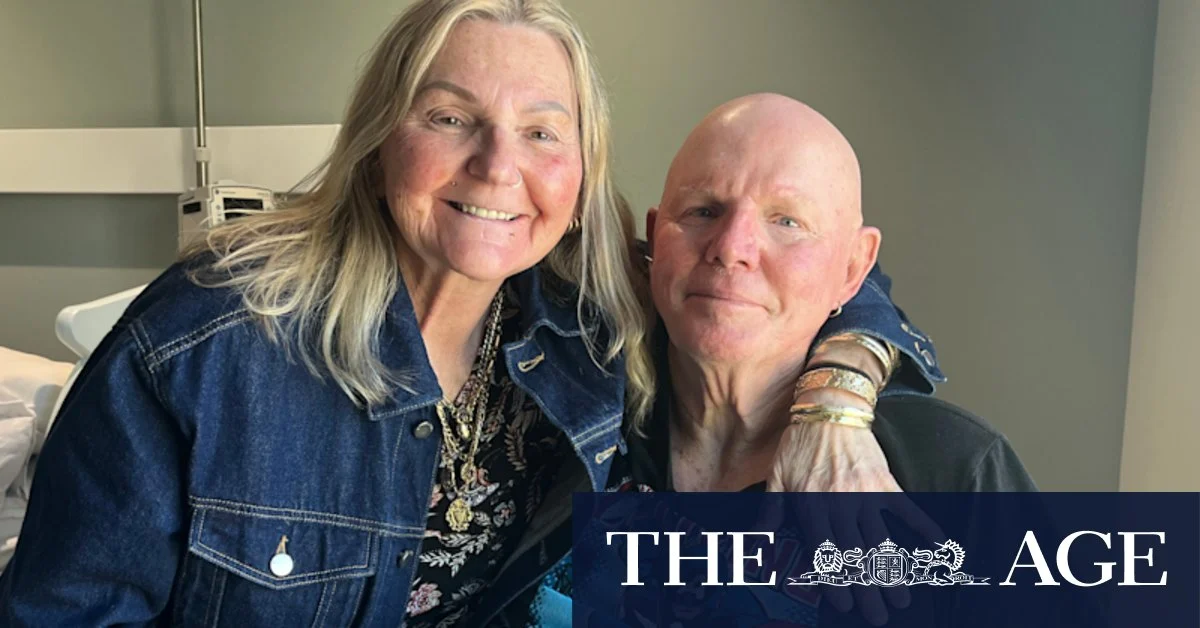

After medical care that totalled nearly $200,000, Rance said he opted for a revisionist ankle replacement when the pain became to worsen about six years after the accident.
He had the operation at Fremantle Hospital in May this year, where he says everything went according to plan.
But at his six-week review he realised something was wrong.
His skin was unable to heal at a certain spot on his leg, which happened to cover his tendon.
“It didn’t hurt or anything, it was just numb,” he said.

Wayne Rance’s injury in its early stages.
Rance said he was advised to keep an eye on it and to keep it dressed, but still, his skin refused to heal.
He even visited a plastic surgeon to talk about potentially getting a skin graft to close the open wound, but doctors were hesitant due to the injury’s position over his tendon.
He said they did not want to remove the covering on his wound as a precaution, and not to aggravate the skin further.
However, following a medical treatment to try to clear the wound for any potential skin graft, a second injury erupted on his lower shin, and he went to Fiona Stanley Hospital.
When he went back in to speak to doctors, she alleged one took a pair of tweezers, removed the covering she had been advised to keep on for the safety of his tendon, and pulled a stitch from his leg that had failed to dissolve.
“I said, ‘Wow, you took that off,’” Rance said.
“Everybody else was saying you can’t take that off.”
Rance said he was re-bandaged, not given any antibiotics and sent on his way.
Over the following weeks, he travelled down south with his wife to visit family.
Around this time, he started getting ill.
“I was shivering, I was so cold – I was getting really, really bad,” Rance said.
A medical service attended, and said Rance needed to act quickly as one of his wounds was infected.
“They came around and they said, ‘No, this is ridiculous … you better go and get intravenous antibiotics’,” he said.
Rance said he attended urgent care and his own GP, and his temperature reached 39.2 degrees before he could get to Fiona Stanley Hospital.

Wayne Rance’s injury after it had become infected and its coverings were removed. The image has been blurred.
There, medical staff removed the bandage to examine the wounds.
Rance alleged his wound was left open until a few hours later, when an observing doctor saw it had also “died” due to drying out.
“She said, ‘You should fill out a complaint about that … heads will roll over that,’” he said.
Following further treatment and a meeting with Fiona Stanley staff about infection management, Rance said a decision was made.
“They told me – on my birthday … they’re going to amputate,” he said.
Rance, whose active life involved travelling, caring for grandchildren and renovating his house in Leda, was devastated.
“I was very angry,” he said.
“Because it didn’t need to get to that point.
“It could have been saved … the alarm bells were ringing at Fremantle.”
A spokesperson for the South Metropolitan Health Service said their clinicians were highly skilled, and made informed decisions for their patients.
Loading
“We acknowledge that an amputation is a very distressing outcome for a patient,” they said.
“For that reason, we ensure all patients, including those with significant co-morbidities and elevated risk factors, are provided with extensive patient counselling to ensure they are fully aware of their health options and risks so they can make well-informed health decisions.”
While unable to comment on individual circumstances or details surrounding treatment of patients due to privacy laws, they confirmed the ankle surgery was not routine.
“It was a revision ankle replacement, which is a complex, high-risk foot and ankle surgery,” the spokesperson said.
“The risk and benefits of operative and non-operative management are discussed with patients before undergoing this kind of surgery.”
Rance said he believed the infection should have been better managed and his quality of life would be forever changed.
“I’m very active,” he said.
“But now I just feel lost … I just couldn’t process it, and I’m still finding hard to process.”
Start the day with a summary of the day’s most important and interesting stories, analysis and insights. Sign up for our Morning Edition newsletter.