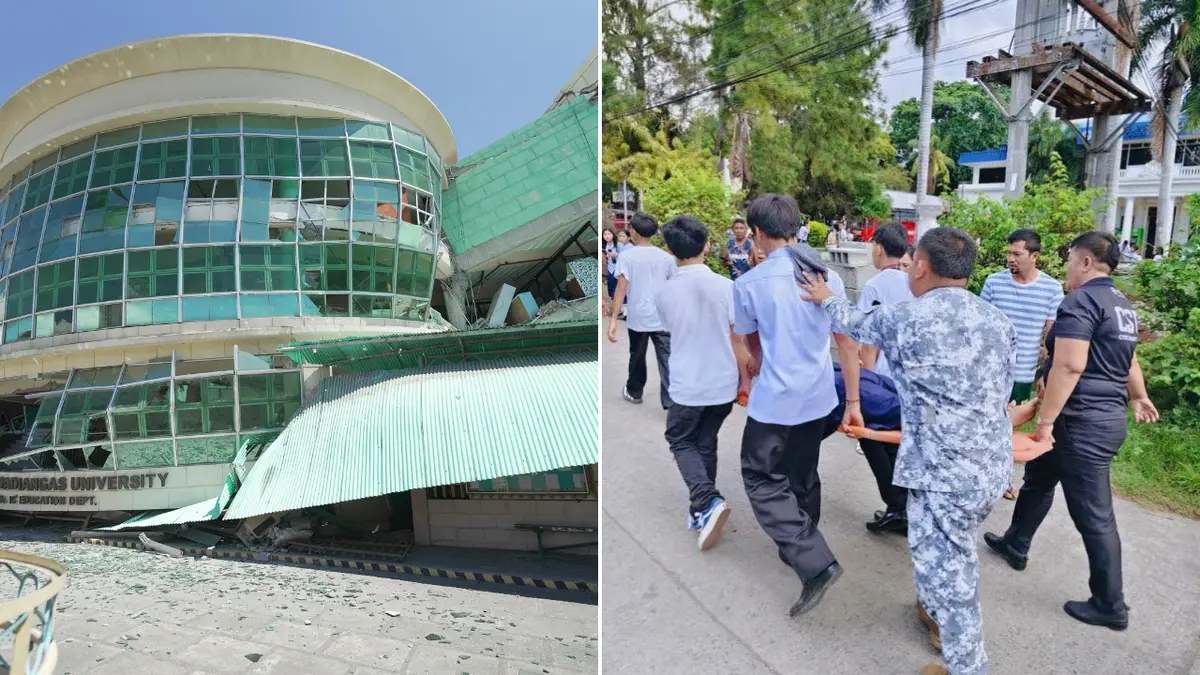

At least 19 people have died and 134 have been injured after a powerful 7.8-magnitude earthquake struck the southern Philippines.
The earthquake rocked the Mindanao region about 7.30am on Monday, local time, with US Geological Survey saying the quake struck undersea at about 24.7km west-southwest of Burias and at a depth of 35km.
The country’s civil defence office said the death toll had risen to 19, while 134 people were injured and seven remain missing.
Know the news with the 7NEWS app: Download today
Police estimate 37 buildings, mostly commercial properties, were damaged.
The earthquake also triggered a tsunami in six areas of Mindanao, with the highest waves reaching 1.4m.


The Pacific Tsunami Warning Centre issued a tsunami warning for the Philippines, with warnings also mentioning possible 1m waves in Indonesia and Malaysia.
The warnings were later lifted.
Residents in Mindanao’s coastal communities have been urged to move to higher ground and to listen to tsunami warnings.
Authorities have recorded 138 aftershocks since the initial quake, ranging from magnitude 1.3 to 6.7.
The international airport in General Santos was temporarily shut due to the earthquake and 17 domestic flights were cancelled.
Master Sergeant Robert Dagon of General Santos City police earlier said at least one person had died and four people had been injured after a “number of buildings” and homes had collapsed.
“Many buildings were affected, but I cannot enumerate them now because we are busy with ongoing rescues,” he told the Agence France-Presse news agency.
Public schools had reopened nationwide on Monday after summer holidays from April to May.
More than 100 students attending morning flag-raising ceremonies in the southern region sustained bruises and some fainted in panic, said disaster-response official Ednar Dayanghirang.
Local school, Mantanao National High School, shared terrifying footage of students running to safety before a building collapses.
The school confirmed that all students were safe and accounted for, having been outside during a morning flag raising ceremony when the earthquake hit.
The earthquake also caused damage in Indonesia’s North Sulawesi province, more than 200km from the epicentre.
It was also felt in Malaysia’s Sabah state on Borneo island.

The earthquake prompted the Joint Australian Tsunami Warning Centre (JATWC), which operates within the Bureau of Meteorology, to place the Northern Territory and Christmas Island on Tsunami watch.
The watch was cancelled a short time later, with JATWC saying “no tsunami waves have been observed that pose a threat to the Australian mainland, islands or territories”.
Footage shared on social media shows a building with a Jollibee fast-food chain logo collapsing as stunned locals watch on.
A media release from Philippines President Ferdinand Marcos Jr said he had directed government agencies to immediately respond, with the office of Civil Defense coordinating disaster response and rescue operations.
Evacuation centres and relief supplies have also been organised as damage assessments are carried out by local government authorities.
Marcos also ordered the suspension of classes and has closed all schools in the affected areas in Mindanao until further notice.
The Philippines is one of the most seismically active regions in the world, and sits on the Pacific “Ring of Fire”, which refers to an area of seismic fault lines and volcanoes.
Several fatal earthquakes struck the Philippines last year, including a 6.9 magnitude quake that rocked the coast of Cebu in September, killing at least 72 people and causing extensive damage.